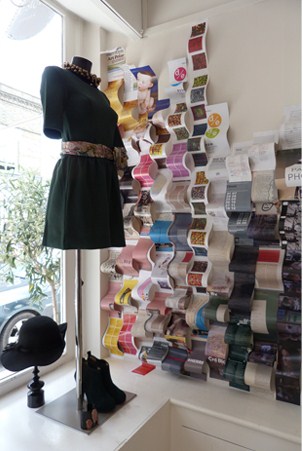
The Time I Went to Paris

On 8 October I took a train to Paris. I arrived there just after the capital’s fashion week had ended, which gave me the chance to visit beauties such as the Oh So London exhibition in the high-end department store Le Bon Marché without the hustle and bustle of all the people brought into the city by the event.

The Le Bon Marché exhibition was very well thought-out. It showcased a collection of Bryan Ferry’s albums, a whole section dedicated to Kate Moss and a few collections by British celebrity-come-designers such as Lucy in Disguise (Lily Allen) and Pretty Green (Liam Gallagher). I wasn’t exactly allowed to take pictures (a mysterious plain-clothes security guard told me off as soon as I zoomed into a bunch of Lanvin ties), but I did my best.


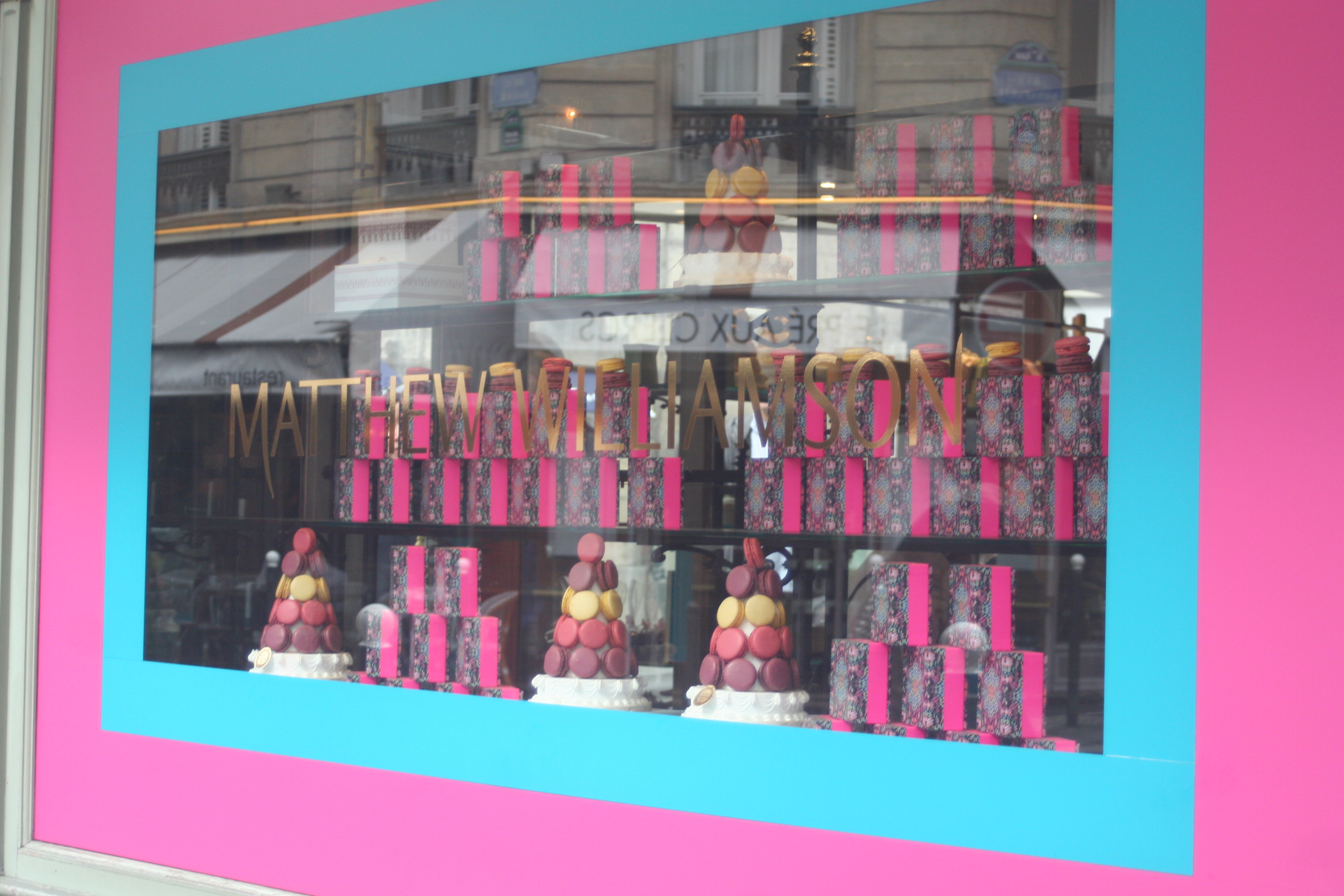
Walking around Paris you cannot avoid stumbling upon all sorts of wonderful things almost constantly. The best of my visit included a whole pink-and-blue window dedicated to Matthew Williamson’s chocolate, a Russian tea chain shop called Kusmi, a gorgeous Isabel Marant window, the biggest Zadig et Voltaire store ever seen by human eyes and a very elegant tea and candle company called Mariage Frère – Comptoir deThé (the Darjeeling candle is on my Christmas wishlist).

One of the highlights of my trips, however, was a unique and beautiful jewellery shop, which I reached at the end of a long walk from La Frégate, a great upmarket-yet-affordable restaurant on the Rive Gauche, where I had a mouth-watering confit de canard with garlic roasted potatoes…

Going back to the jewellery shop (!), this little boutique is called BRAI exclusive and takes its name from the homonymous jewellery collection created by two of the most inventive jewellery designers I’ve met in a long time. Delphine Pariente started off her career designing bags in 1998 moving to jewellery pretty soon after and hasn’t stopped creating one-of-a-kind pieces of art since. Her co-designer Claire Naa is also extremely creative and is the creator of the origami jewellery. I bought two pink gold little pendants, but it was very hard to choose.


Unhappy with the huge (but seemingly not sufficient) amount of cash I had spent until that point, I went vintage shopping. I was lucky there. Shall we talk about how cheap quality vintage is in Paris? I headed to the hip area Le Marais and visited Fripes Star, Free ‘P’ Star (my favourite) and Le Verger du Prince among others. I bought a lovely blue polka dot 1940s dress, a skirt, two pairs of shoes, a jumper and a hat, all way under £20 each.

Oh Paris, I want to come and see you again!

The Best Shop in Lisbon

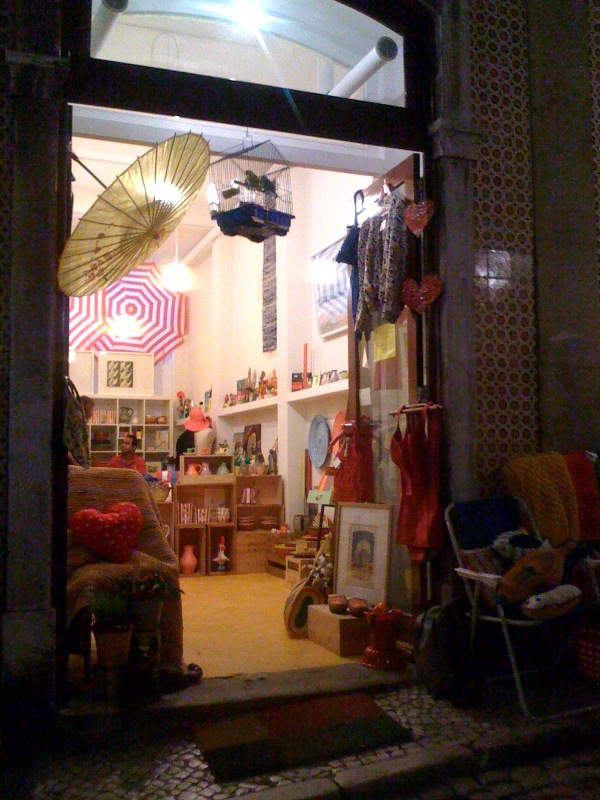
In the centre of Mouraria, a small up-and-coming area behind Alfama, sits A Loja, an incredibly inspiring vintage shop. The owner is a very sweet young French lady who loves all things original and vintage.

First of all, I have to apologise for the quality of pictures. When I first found this gem of a shop, it was night time and a brilliant little street party was in full swing. A few people were jamming in the tiny square adjacent to it and the restaurant right on the square was selling drinks (double shots, a large wine and everything in between) €1 per glass. I stopped by, drank, danced, made friends, bought a lovely little book from A Loja and took a few pictures of the shop with my mobile phone. A couple of days later, before my return to the UK, I decided to take more pictures, this time with a film camera, in the daylight. Unfortunately the daytime pictures didn’t work out as the camera went crazy and I had to resort to my first batch of mobile photos!

A Loja is full of vintage clothes, books (the one I bought was a very affordable 1969 copy of Sociologie de la Mode, by René König), small furniture such as chairs and shelves, cushions, vinyls, bowls and all sorts of charming knickknacks. A cage was hanging above the door with two colourful birds in it and more often than not you’ll hear crackling 1950s music playing which will definitely get you in the vintage mood.

If you happen to stop by in Lisbon, this is a wonderful little shop that has to be visited! You will not be disappointed.

A Loja, Largo dos Trigueiros, 16B, Lisbon.

Run Baby Run

Sorry, everyone. I know it’s been ages, but I’ve been very busy in the last three weeks or so. First of all, I have been working shifts at unsociable hours which have left me tired-eyed and sleep-deprived. Don’t get me wrong, I love my job, and shifts can be useful if you have stuff to do during the day, normally. But when you struggle to get to sleep at night and then you’re up before the sun rises, believe me, you do feel the exhaustion.

Another reason why I have been somewhat absent from your dearest minds (but surely not hearts), is that I did a little stint in Lisbon, taking pictures, visiting castles (or the outside of) going to the beach (jealous yet?) and window shopping. Fear not, I am already planning two different posts about it.

Last but not least, the final reason why my blog has been quite quiet of late is because I have been training for my 5K Big Fun Run which will take place in Victoria Park on 2 October. Oh yes I have! I have been eating very healthily – excluding of course my birthday weekend! I have also been running fairly regularly and currently can run for half an hour non-stop, non-walk in Hackney Downs.

(Photo source: http://www.gthc.org.uk/fundraising/?event_id=45156)

Despite being tiny, Hackney Downs is a great park to train in, as it has flat parts and steep uphills and downhills. Some of its corners are nice and cool as they remain in the shade most of the time because of big trees whereas other parts are very open and generally sunny (if and when the British weather graces us). It is just around the corner from my little flat and, apart from the occasional crack-indulging happy neighbour smoking away on the bench, it’s perfect. Mind you, I haven’t done 5 full kilometres yet, but last year I didn’t even train at all and managed to run it all because the people and general buzz were great and very encouraging, so I trust I shouldn’t have any major problem this year (touching wood).

(Photo source: http://en.wikipedia.org/wiki/Politics_of_Hackney)

The charity I’m running for is Children with Cancer. I chose it because many years ago my family lost a child to Leukaemia so I decided I’d help as much as I can for other families, now and in the future, not having to experience the same loss. I would be very grateful if you decided to support me in this rather challenging(!) undertake, I’m sure everyone realises how important this cause is. My fundraising page is http://uk.virginmoneygiving.com/ManuelaCalascibetta, make sure you select the page on the left as the one on the right was last year’s. Thank you.

(Photo source: http://scottishrunningguide.com/news.php/500/big_fun_runs_kick_off_this_weekend/full)

I shall be back soon with new posts!

The Skin I Live in, by Pedro Almodóvar

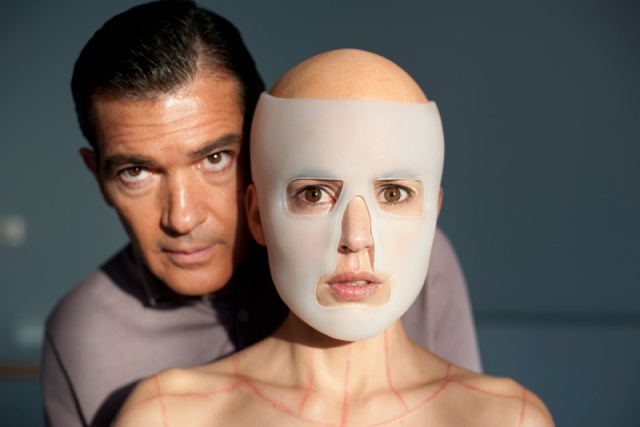
Pedro Almodóvar’s latest film, The Skin I Live In (La piel que habito) is a fine, elegant horror “without any blood”, as the director himself defines it. The plot, loosely based on Thierry Jonquet’s novel Mygale, tells the story of plastic surgeon Robert Ledgard, who is looking for revenge whilst also developing a new type of pain-, fire- and mosquito-resistant skin. In the story, Robert’s wife passes away after a terrible car crash that burnt her whole body, which is the main reason why he embarks in his new skin studies. Parallel to that, the audience is shown that the surgeon’s estate/plastic surgery clinic is also a prison for young patient Vera Cruz. As the story unravels through a compelling (if somewhat unsettling) series of flashbacks, typical of Almodóvar’s style, the viewer discovers the horrifying plot, tassel by tassel. The main topics of this work being grief and cold-blooded vendetta, The Skin I live In digs into the main characters’ backgrounds, psyche and dysfunctional behaviours, to the point of guiding the audience into their psyche to deeply understand (although not agree with!) their actions.

(Picture source: http://uk.movies.ign.com)

All the classic Almodóvar themes can be found in his latest venture: in this film hospitals play an important part representing a reassuring prison; the wealth and opulent residence and belongings of the characters, who generally have mental issues, the unconventional domesticity and the dramatic staircase scenes are also to be counted among those reoccurring patterns, present in the movie, that the director chooses to use regularly. Betrayal, the exploration of male desire, dark comedy paired to tragedy and a clinical, unapologetic approach and critic to delicate social issues are other main themes chosen to be part of this masterpiece.

(Picture source: http://uk.movies.ign.com)

Almodóvar plays very cleverly with our minds just like Robert plays with Vera’s by adding several motifs throughout the film’s 117 minutes. The scene where Vincente, a shop assistant, dresses a mannequin sexualising the object is mirrored by the same character, later on in the story, having an encounter with a girl whom he treats like an objectified prey. The theme of clothing and, more in general, cloth, is also very strong and symbolises something merely disposable – both skin and clothes, in fact, are cut in small parts or placed together like patchwork. The way Robert moulds his victim’s body is also represented by the way the victim creates gauze-covered sculptures. The victim owns the sculpture and is owned by Robert.

(Picture source: http://uk.movies.ign.com)

Unfortunately, the subtlety of the original title’s word play was lost in translation. Despite the awkward sound of the phrase ‘the skin I inhabit’, I think this would have been a better translation for the title. The original Spanish title sounds also unnatural, and the word ‘inhabit’ holds in itself the word ‘habit’, which reminds us of clothes and material, very important elements of the film, as we have discussed. Moreover, ‘inhabit’ gives an even stronger sense of distance. The character does not live in their own skin, but rather, in someone else’s skin and, as an extent, someone else’s image and identity. This word makes us understand that the person who inhabits that skin takes on the given role like a played character, wears it as a uniform and ultimately decides to move from victim to conscious and active betrayer, with a final scope in mind.Marilia, Robert’s servant, also wears a uniform, and when she returns to work for him after years, she is happy to wear it again. This shows us how the surgeon has a great captivating power on people and just how happy they are to preserve normality and adhere to their subdued, subjugated roles.

(Picture source: http://uk.movies.ign.com)

Much importance was given to the clothes during the planning and production stages, so much so that Jean-Paul Gaultier worked side by side with the film’s costume designer, Paco Delgado. The choice couldn’t have been more appropriate, with the fashion designer’s clean and minimal lines. The zips and the cut-out, circular breast seams add a kinky theme to it all, which perfectly suits the tone and motifs of the movie.

In a few words, Almodóvar’s wonderful latest work can be described as horror comedy, dark, unconventional, fetishistic, funnily awkward, straight to the point, technically perfect and definitely unexpected. I strongly recommend you go and see it, you will not regret it!

A/W ’11 Trends – She’s a Femme Fatale

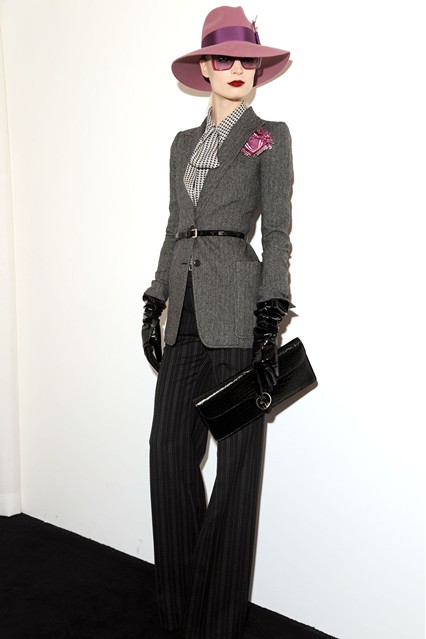
This year has seen a rebirth of the Femme Fatale and a sudden rise in the 1940s’ trend. Vamping it up and adding va-va-voom are de rigueur to stand out in the approaching winter months.

(Picture source: www.vogue.co.uk)

Midi skirts, pretty pussy-bow blouses, cinched-in waists, tailored jackets, hyper-feminine tea dresses, full red lips and flirty hats all appear in the must-have list if you want to follow this lady-like trend.

(Picture source: http://www.marieclaire.com)

Of course this trend spans over 10 years of fashion history, and, as such, it has different influences, particularly originated from the circumstances due to World War II. At the beginning of the decade, with most countries being crippled by the poverty dictated by the international conflict, the hems went up to use less fabric and the shapes became more relaxed as women needed looser, more comfortable clothing in order to move and work. But by the end of the decade, women were tired of the figurative and practical cuts caused by warfare, and in 1947 Christian Dior introduced his New Look Collection (term coined by the American fashion-magazine editor Carmel Snow), which featured extra full skirts, tiny wasp waists and sloping shoulders, in contrast to the squared, military shoulders that were in use at the beginning of the decade. The skirt became longer in contrast to the early ‘40s (twelve inches or less from the ground), sustained by a taffeta petticoat.

(Picture source: http://www.vintageconnection.net/NewLook.htm)

Current designers have put together both sides of the ‘40s and adopted the full skirt as long as the slim-fit one. Built-in support is key to this style, a feature that is still present two decades later, as showcased in Mad Men. This winter, colours are going back to the Forties too, seeing deep burgundy, bottle green, mustard and rich browns on the main palette. At the same time, also other, more daring shades are introduced, such as shocking pink, bright red and lilac, to modernise this vintage look.

(Picture source: http://www.marieclaire.com)

An endless list of designers, including Frida Giannini at Gucci, Miuccia Prada, Jean Paul Gaultier and Donna Karan have dipped into Forties glamour, adding furs, pearls, gloves and shrugs as final touches and, of course, including both styles of midi skirts. This trend is wonderful for complimenting womanly figures and creating curves, and is very flattering on pretty much all shapes and forms. Wear it with chunky, platform Mary Janes, leather inserts in skirts and blouses and long hair falling on your shoulders to keep it fresh and updated.

(Picture source: http://www.myfashionlife.com)

Super Special Carrot Cake

Let me give you a bit of a background on this recipe. About three years ago I found it on the BBC Food website and made the cake for a picnic. I was very happy with the results so decided I would have made it again ‘soon’. That ‘soon’ arrived about two years later, when I looked for that same recipe high and low on the internet for hours, without ever finding it again. Bitter disappointment kicked in. Ah, if only I had made it more often, I probably would have remembered the recipe by heart! Then, about a couple of months after that sad incident, I decided to tidy up the two boxes on top of my wardrobe and there it was, a print-out of the recipe! I had completely forgotten I had printed it out. I thought I was going to faint from the excitement. Instead, I transcribed it into my recipe book to keep it safe and that’s how I can bring it to you. I recently made this cake for the office, and my colleagues wolfed it down, which I took as a good sign. So here’s what you’ll need:

For the cake

  • 250 g unsalted butter
  • 375 g caster sugar
  • Grated rind of 2 oranges
  • 4 eggs
  • 450 g carrots
  • 150 g chopped nuts (I generally use walnuts but you could try almonds or pecans)
  • 1 tbsp vanilla essence
  • Juice of 1 orange
  • 250 g plain flour
  • 2 tsp bicarbonate of soda
  • 1 tsp mixed spice
  • 1 tsp salt

For the icing

This will yield plenty of icing, a little more than you’ll need for the cake, but it’s so rich and tasty, you’ll want to use it on everything! Otherwise you could reduce all of its ingredients of 1/3.

  • 225 g mascarpone cheese
  • 65 g unsalted butter
  • 400 g icing sugar (I never said this recipe was low-calorie!)
  • 1 tsp vanilla essence

Preparation

Preheat the oven to 180°C/gas mark 4 and grease a 23cm/9in tin. Grate the carrots and orange peel, then beat the softened butter, sugar and orange rind together until light and fluffy.

Gradually add the eggs to the mixture and then fold in the carrots and grated nuts. Add the vanilla essence and the orange juice. The mixture will look very liquid at this point but fear not! It’s all under control. In a different bowl, sift the flour, bicarbonate of soda, salt and mixed spices together and fold into the mixture gently. It will still look pretty runny and pale, but this is good, because it means that your cake will be soft and moist. Pour the mixture into the tin and bake for 50 to 70 minutes, depending on how efficient your oven is. You’ll know the cake is ready once its sides come away from the tin and a skewer comes out clean, if a little wet. Don’t worry if the final result looks much darker than the mixture you initially placed into the oven, this is completely normal. Finally, make the icing by creaming the mascarpone and softened butter together until smooth, add the icing sugar and vanilla essence and mix until it is all homogenous.

This frosting is amazing! Spread it generously onto the cake once it’s cooled down a little and enjoy.

Natural Glow

This is a product feature page I worked on with the help of photographer Roland Taylor. The theme was organic products for the summer.

The Baby Dilemma: Why I Don’t Feel Selfish for not Wanting a Baby

From an early age, girls are encouraged to play with dolls; they are given the impression that they can be whatever they want to be, from business women to teachers to actors, but ultimately, their role will be to procreate. And so most girls grow with this idea in mind that, one day, they’ll give birth.

By gradually approaching the average birth-giving age, however, women develop their own ideas about it. Personally, I am terrified by the idea of having a child. I have serious doubts about the topic and am ready to bet that most women have, too.

My feelings towards this issue have changed through the years. In my late teens and early twenties I thought I was going to finish my university course, find a man and start a family. But when my course ended I realised I felt too young and thought it would’ve been a waste to work on my education without putting it to good use after. Time passed. I found myself one of those boyfriends your parents like. He bought us a house with a spare room for the dreaded creature, but the relationship didn’t work out and after over three years we broke up.

A mini crisis ensued when, at the seemingly geriatric age of 26, I was stopped in the middle of my development towards the happy family ideal I had in mind. At that point I seriously thought I was going to end up sad and alone, in a filthy flat full of cats, with knots in my hair the size of a ball of yarn. That was it, I had missed the boat. All of the motherly women I knew had already had children by the time they were my age, and I was left stranded.

Picture source: http://www.fempop.com/2011/06/24/prime-gossip-britneys-new-vid-chris-brown-is-the-worst-and-jennifer-aniston-is-a-hypocrite/

This made me wonder why it was apparently of such pivotal importance to me to have children. Was it to feel safe in the knowledge that I had a future insurance, someone to look after me and cook me a roast for Christmas? Or the need to feel needed, which would feed into my shaky self-esteem? Or a way to secure myself something of my own and a sense of belonging? Suddenly, I stepped back and woke up to the fact that pregnancy is extremely harsh on the body, to say the least. It brings with it a magnitude of health issues, affects your veins, back, skin, heart, digestion, even your teeth. And need I delve into the revolting list of labour-related facts? I think we all have heard more horror stories about this topic than we can stomach.

I suspected this last change in attitude on my side might be due to the disillusionment I had from the failure of my previous relationship, so I decided to ask around to girls who are roughly my age. My colleague Sara told me how she and her husband looked after their five-year-old niece for a weekend. All she got from it was not the warm and fuzzy feeling of tenderness only a child can give you. No. She only got a boring time, and nits. Needless to say that she now does not want any children at all. My flatmate Lauren pointed out that children might be sweet, but (and this has to be one of the most uttered sentences of all times) only when they’re someone else’s so you can give them back. To that she added “Why would I waste my efforts trying to keep trim by then getting fat for a baby?” The last girl I asked was Elena, who reported how much of an uncivilised affair family dinners are at her sister’s house, with food negotiations with the kids worth a final try by the Head of State. She doesn’t feel ready to give up her romantic holidays and having to spend her hard-earned money on someone who’s hardly going to be grateful.

Statistics tell us that the average age for a woman to have her first child is rising exponentially, and I think this is because women are trying to buy themselves some time to make sure they make the right decision, and not hurry into having children “quick, before it’s late o’clock!”. I have to say this is reassuring as, at the moment, I am currently far from sacrificing my freedom, health, independence and fun-and-impromptu nights out for another human being. I still think that motherhood and I will make peace again at some point, but for now, I’m happy I don’t have to.

The Baby Dilemma: Why I Don’t Feel Selfish for not Wanting a Baby

From an early age, girls are encouraged to play with dolls; they are given the impression that they can be whatever they want to be, from business women to teachers to actors, but ultimately, their role will be to procreate. And so most girls grow with this idea in mind that, one day, they’ll give birth.

By gradually approaching the average birth-giving age, however, women develop their own ideas about it. Personally, I am terrified by the idea of having a child. I have serious doubts about the topic and am ready to bet that most women have, too.

My feelings towards this issue have changed through the years. In my late teens and early twenties I thought I was going to finish my university course, find a man and start a family. But when my course ended I realised I felt too young and thought it would’ve been a waste to work on my education without putting it to good use after. Time passed. I found myself one of those boyfriends your parents like. He bought us a house with a spare room for the dreaded creature, but the relationship didn’t work out and after over three years we broke up.

A mini crisis ensued when, at the seemingly geriatric age of 26, I was stopped in the middle of my development towards the happy family ideal I had in mind. At that point I seriously thought I was going to end up sad and alone, in a filthy flat full of cats, with knots in my hair the size of a ball of yarn. That was it, I had missed the boat. All of the motherly women I knew had already had children by the time they were my age, and I was left stranded.

Picture source: http://www.fempop.com/2011/06/24/prime-gossip-britneys-new-vid-chris-brown-is-the-worst-and-jennifer-aniston-is-a-hypocrite/

This made me wonder why it was apparently of such pivotal importance to me to have children. Was it to feel safe in the knowledge that I had a future insurance, someone to look after me and cook me a roast for Christmas? Or the need to feel needed, which would feed into my shaky self-esteem? Or a way to secure myself something of my own and a sense of belonging? Suddenly, I stepped back and woke up to the fact that pregnancy is extremely harsh on the body, to say the least. It brings with it a magnitude of health issues, affects your veins, back, skin, heart, digestion, even your teeth. And need I delve into the revolting list of labour-related facts? I think we all have heard more horror stories about this topic than we can stomach.

I suspected this last change in attitude on my side might be due to the disillusionment I had from the failure of my previous relationship, so I decided to ask around to girls who are roughly my age. My colleague Sara told me how she and her husband looked after their five-year-old niece for a weekend. All she got from it was not the warm and fuzzy feeling of tenderness only a child can give you. No. She only got a boring time, and nits. Needless to say that she now does not want any children at all. My flatmate Lauren pointed out that children might be sweet, but (and this has to be one of the most uttered sentences of all times) only when they’re someone else’s so you can give them back. To that she added “Why would I waste my efforts trying to keep trim by then getting fat for a baby?” The last girl I asked was Elena, who reported how much of an uncivilised affair family dinners are at her sister’s house, with food negotiations with the kids worth a final try by the Head of State. She doesn’t feel ready to give up her romantic holidays and having to spend her hard-earned money on someone who’s hardly going to be grateful.

Statistics tell us that the average age for a woman to have her first child is rising exponentially, and I think this is because women are trying to buy themselves some time to make sure they make the right decision, and not hurry into having children “quick, before it’s late o’clock!”. I have to say this is reassuring as, at the moment, I am currently far from sacrificing my freedom, health, independence and fun-and-impromptu nights out for another human being. I still think that motherhood and I will make peace again at some point, but for now, I’m happy I don’t have to.

Interview with Wild Swans Boutique’s Owner Caroline Van Luthje

Wild Swans is not your usual boutique. It has a predominantly Scandinavian theme, for one; its three locations don’t even go near the usual Covent Garden/Marylebone/King’s Road indie-shop hotspots; and finally, its owner and creator Caroline Van Luthje opened it after a long career in . . . TV production. She started with her first shop in Chiswick in 2005 and it went so well that last year she opened the Islington branch. This year it’s the turn of the Mill Hill store, all three areas with that quintessential village feeling that Caroline was mainly keen on. So how has Wild Swans come to be one of the most remarkable names in the field in only four years? I recently met Caroline to find out more about what her business is all about.

MC: How did you decide to move to London and open a boutique from originally being in TV production?

CVL: When I first moved to the UK, my initial goal wasn’t to open a shop. But then I realised that, even after moving here, I was still going back home to buy my clothes, because most of the designers I liked were simply not available inLondon. So at that point I decided that I was ready to try something different and, despite not having any retail background, I went for it. Retail is the third biggest export inDenmark, so outsourcing material from there wasn’t actually unusual.

MC: How do you choose the designers and pieces that you showcase? And how do you find new and upcoming designers?

CVL: I tend to go toDenmark on a regular basis with another member of my team to attend retailers’ fairs and fashion shows and meet suppliers, and we usually choose different pieces from there that go together and adhere to the classic yet edgy style of our shop. When selecting new and upcoming designers instead, we trust the word-of-mouth method within the industry or we read specialised magazines.

MC: You say that the great majority of the products in store are Danish or at least Scandinavian, except for a couple of names like Jaime Mascaro and American Vintage. How come did you decide to make an exception for them?

CVL: We always aim to give a style that is complete – we like our clients to get into our shops and find different pieces that would work together harmoniously into a full outfit. So for example Jaime Mascaro’s shoes are so comfortable and they offer a great choice of ballerinas and evening shoes, therefore we decided to keep that name in store. With American Vintage, instead, we really like their recent collections and found that as a brand it was quite difficult to find, so we decided to have it just to cover that gap in the market.

Photo source: http://www.wild-swans.com/

MC: How has the trend of your shops and the clientele changed through the years?

CVL: The trend of the shop (and its clientele) has always been mixed, really. Our customers’ age spans from 25 to 70 years old and so we have always tried to meet their needs depending on their profile and background. For example, in the new store we opened in Mill Hill, which is in the middle of a great Jewish community, we have noticed a need for dresses and skirts with a slightly stretched length that can cover the knee for attending the Synagogue. That comes as a new challenge to us and we are currently seeing different designers to see whether they would be happy to adapt the design of a few of their dresses for that.

MC: How would you say the credit crunch has affected the way your clients shop? Would you say it increased the need for “slow fashion”?

CVL: I felt that people in general were a little frightened at the beginning and because of the downturn we were mostly in danger as retailers, being in the “middle market” bracket. But slow fashion is actually taking over more and more and so are dedicated and independent boutiques that offer good quality and unique clothes, therefore so far we’ve been doing quite well, in fact.

MC: What is the future of independent shops, in your view?

CVL: Independent shops are just going to get stronger and stronger. There is a big demand for an independent boutique style, and all we need to do is to create a niche and have something different to offer. Since we started off in 2005 we’ve always been trying to tweak what we offer to improve it and give our clientele what they are after. From seasonal clients’ evenings with designers to the occasional free manicure service in store, you always need to give that little bit more to be a bit different.

MC: I heard that you have been shortlisted for the Drapers Award this year!

CVL: Yes, they called in the shop and announced that we were shortlisted. 50 shops were initially nominated and now there are only 9 of us left now. We’ll find out if we’ve won on the 18 November!

MC: What is the fashion scene like in Scandinavia?

CVL: It is much easier to spot trends up there. For example you walk into a café and see straight away a bunch of girls wearing the same trend, similar clothes etc, and you get that less often inLondon. The general styles are not too far from those here in theUK, but at times a few trends arrive there first and then take up here as well, such as harem trousers and playsuits.

For more info about this amazing shop please visit http://www.wild-swans.com/default.